ReflectiveForms.Core
2026.615.28
See the version list below for details.
dotnet add package ReflectiveForms.Core --version 2026.615.28
NuGet\Install-Package ReflectiveForms.Core -Version 2026.615.28
<PackageReference Include="ReflectiveForms.Core" Version="2026.615.28" />
<PackageVersion Include="ReflectiveForms.Core" Version="2026.615.28" />
<PackageReference Include="ReflectiveForms.Core" />
paket add ReflectiveForms.Core --version 2026.615.28
#r "nuget: ReflectiveForms.Core, 2026.615.28"
#:package ReflectiveForms.Core@2026.615.28
#addin nuget:?package=ReflectiveForms.Core&version=2026.615.28
#tool nuget:?package=ReflectiveForms.Core&version=2026.615.28
ReflectiveForms

A schema-driven admin panel framework. Define entities with C# attributes, get a full CRUD admin panel with a modern React frontend — auto-save, display conditions, nested repeaters, entity relations, locking, SSO, AI-powered features (centralized AI assistant with tool-calling, semantic search, sanity checks, NL filtering), OpenAPI spec generation, and more.
Test Results
Last Updated: 2026-06-15 19:47:09 UTC
| Metric | Count |
|---|---|
| Tests Passed | 1711 |
| Tests Failed | 1 |
| Total Tests | 1712 |
Preview
Annotate your C# models — ReflectiveForms generates the full admin UI automatically.
public class BlogPostModel : EntityFieldsModel
{
    [JsonProperty("title"),
     Text(label: "Title", instructions: "", mandatory: true)]
    public string Title = "";

    [JsonProperty("author"),
     Relation(label: "Author", instructions: "", relatedEntity: "user")]
    public string Author = "";

    [JsonProperty("content"),
     WysiwygEditor(label: "Post Content", instructions: "")]
    public string Content = "";

    [JsonProperty("excerpt"),
     TextArea(label: "Excerpt", instructions: "", mandatory: false),
     AISuggestion("Write a 1-sentence summary", "title", "content")]
    public string Excerpt = "";
}
That's it — register it, and the dashboard, list view, and full create/edit form appear automatically.
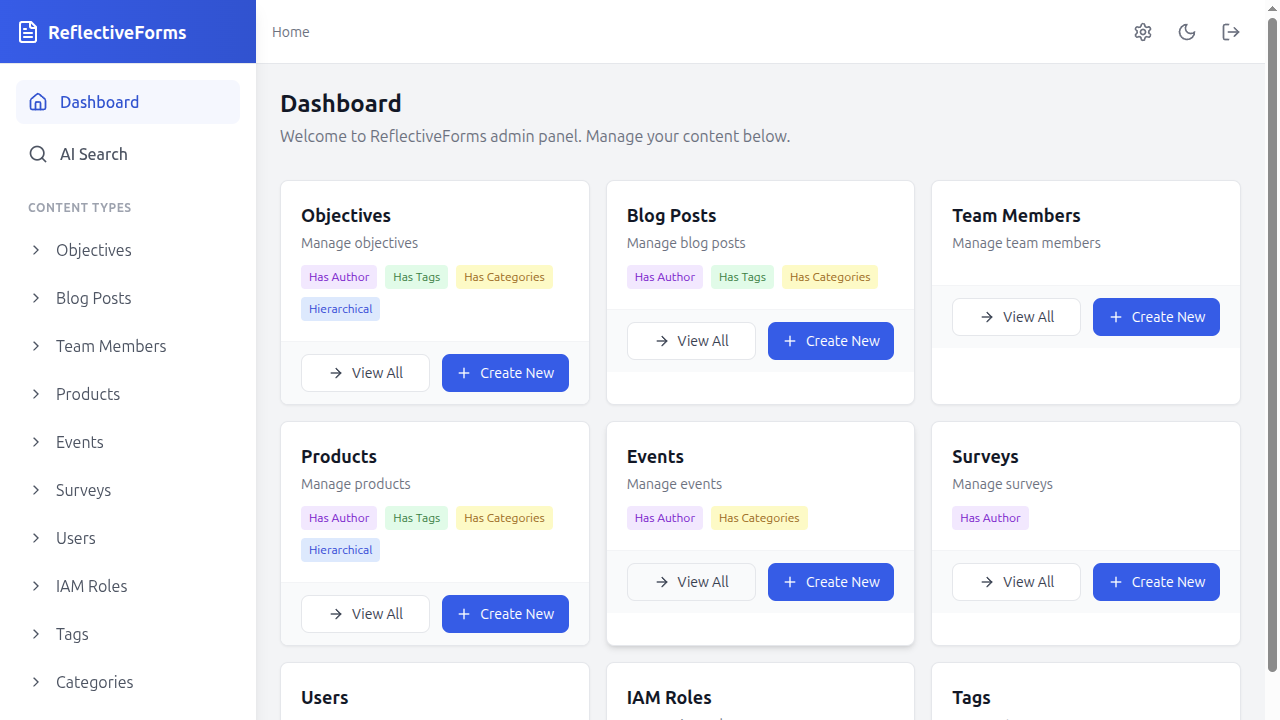 Dashboard showing all registered entity types with View All / Create New actions
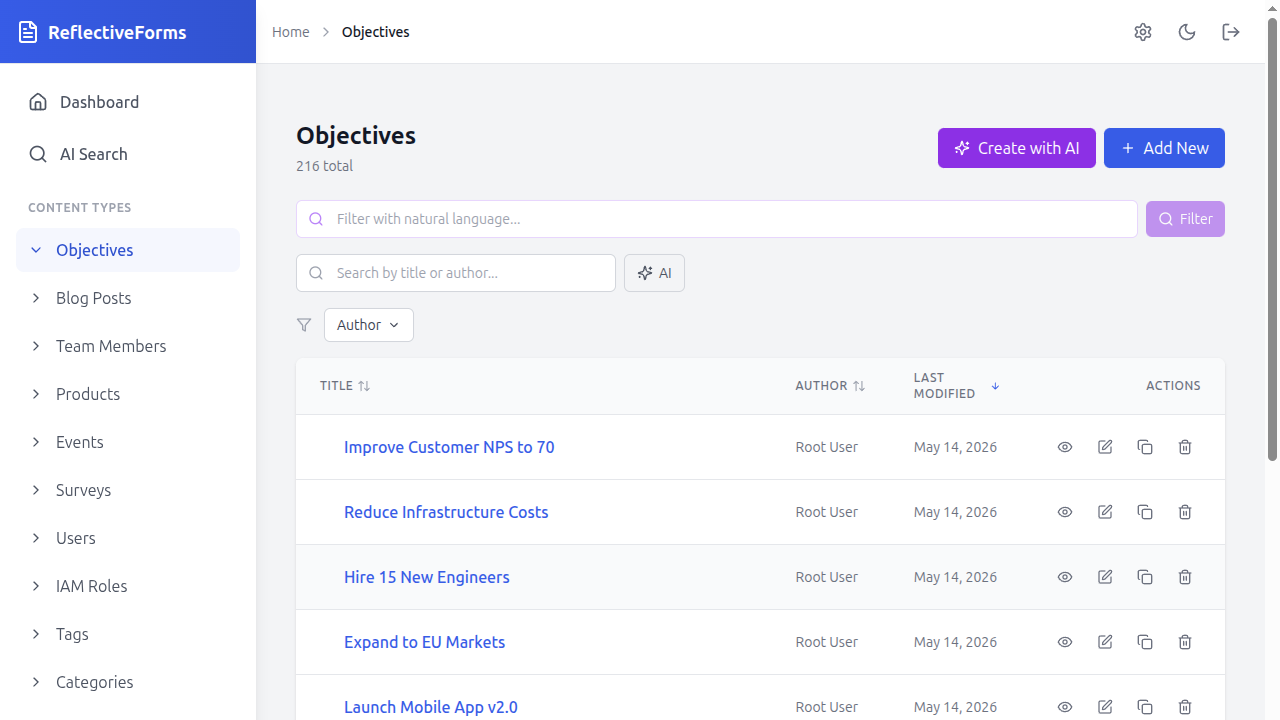 Searchable, sortable entity list with NL filter, AI search, and per-row actions
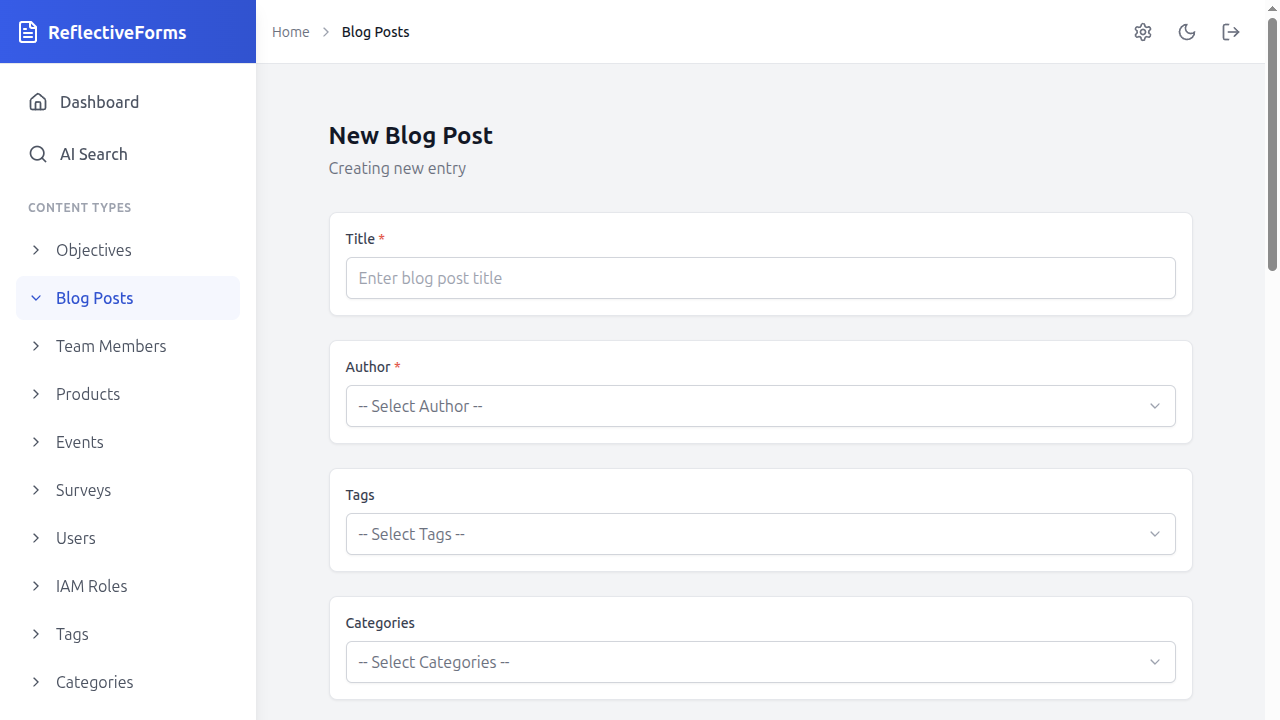 Auto-generated create form with rich field types: title, relation dropdowns, tags, WYSIWYG editor
Packages
| Package | Description |
|---|---|
ReflectiveForms.Core |
.NET 8 NuGet library — entity configuration, schema generation, CRUD API, auth, SSO |
@reflective-forms/frontend |
React + TypeScript npm library — renders schemas as a full admin panel |
@reflective-forms/create-app |
CLI scaffolder — generates a new project with backend, frontend, Docker, and a sample entity |
Quick Start
Option 1: Scaffold a new project (recommended)
npx @reflective-forms/create-app my-project
cd my-project
# Start backend
cd backend && dotnet run
# In another terminal, start frontend
cd frontend && npm install && npm run dev
Option 2: Add to an existing .NET app
Backend:
dotnet add package ReflectiveForms.Core
// Program.cs
using Microsoft.Extensions.Logging;
using ReflectiveForms.Core;

var builder = WebApplication.CreateBuilder(args);
using var loggerFactory = LoggerFactory.Create(logging =>
{
    logging.AddConsole();
    logging.AddDebug();
});
var rfLogger = loggerFactory.CreateLogger<Program>();

var app = builder.BuildWithReflectiveFields(RfBuilder.Build(rfLogger));
app.Run();
// RfBuilder.cs
using CrossCloudKit.Database.Basic;
using CrossCloudKit.File.Basic;
using CrossCloudKit.Memory.Basic;
using CrossCloudKit.PubSub.Basic;
using Microsoft.Extensions.Logging;
using ReflectiveForms.Core;
using ReflectiveForms.Core.Endpoints;

public static class RfBuilder
{
    public static RfConfigurationBuilder Build(ILogger logger)
    {
        var pubSub = new PubSubServiceBasic();
        var memory = new MemoryServiceBasic(pubSub);
        var file = new FileServiceBasic(memory, pubSub);
        var db = new DatabaseServiceBasic("my-app-db", memory, Path.GetTempPath());

        return new RfConfigurationBuilder
        {
            Logger = logger,
            RootUserCredentials = new RootUserCredentials("admin@karasoftware.com", "123456"),
            RepositoryServiceConfiguration = new EntityRepositoryServiceConfiguration(
                db, memory, pubSub,
                new FileServiceConfiguration(file, "my-app-media")),
            EndpointConfiguration = new EndpointConfiguration
            {
                JwtSecret = "change-this-to-a-random-secret-at-least-32-chars",
                RootPath = "/rf",
                PublicUrlRootForApi = "http://localhost:9000/rf/api/",
                PublicFrontendBaseUrl = "http://localhost:3000",
            },
            EntityTypes =
            [
                new EntityConfigurationBuilder<NoteModel>
                {
                    EntityName = "note",
                    EntityReadableNameSingular = "Note",
                    EntityReadableNamePlural = "Notes",
                    SupportsFrontendEdit = true,
                    HasAuthor = false,
                    HasTags = false,
                    HasCategories = false,
                    HasParentChildRelationship = false,
                    RequireGlobalTitleUniqueness = false,
                    OptionalTitleSanityCheck = null,
                    ShowInNavigation = true, // Set false to hide from sidebar & dashboard
                },
            ],
        };
    }
}
Frontend:
npm install @reflective-forms/frontend react react-dom react-router-dom
// main.tsx
import { createReflectiveFormsApp } from '@reflective-forms/frontend';

createReflectiveFormsApp({
  apiBaseUrl: 'http://localhost:9000/rf/api',
  appName: 'My Admin',
  primaryColor: '#2563eb',
});
Features
Entity Configuration (Backend)
- Declarative models — C# attributes:
Text,TextArea,Select,Checkbox,DatePicker,Number,Range,Url,Email,Repeater,Group,Relation,WysiwygEditor,MediaSourceBase64 - Display conditions — Show/hide fields based on sibling values, works inside repeaters at any depth
- Nested repeaters — 3+ levels (e.g. Survey → Sections → Questions → Choices) with min/max enforcement
- Dynamic choices — Select options from async C# methods (compile-time or runtime)
- Dynamic defaults — Runtime-computed default values via async methods
- Sanity checks — Server-side validation with custom async logic (e.g. uniqueness)
- Entity metadata — Tags, categories, parent-child hierarchy
- Role-based access — IAM with per-entity-type CRUD capabilities
- System-managed entities — Root user, Owner role, and sharing admin roles are immutable; backend rejects UPDATE/DELETE with 403, frontend shows read-only view with "System" badge
- Individual sharing — Per-entity access control: share with specific users/roles, public toggle, auto-generated admin roles
- SSO — OpenID Connect, Azure AD, Google with auto-provisioning and domain filtering
- AI features (optional) — Centralized AI assistant with multi-turn chat and tool-calling (entity creation, updates, deletion, field suggestions, navigation — all with user approval), semantic search (vector indexing), AI sanity checks (
[AISanityCheck]), AI field suggestions ([AISuggestion]), revision diff AI summaries, natural language filtering, AI relation suggestions ([AIRelationSuggestion]). All off by default — enable per entity type - OpenAPI spec generation — Auto-generated OpenAPI 3.1 spec at
/openapi.json, independent of AI features
Field Convention Methods (___ Naming Pattern)
ReflectiveForms uses a naming convention to discover four kinds of field-level customization methods. These are methods you define directly on your entity model class, named {FieldName}___{Suffix}. The framework discovers them via reflection — no registration needed.
⚠️ These are NOT lifecycle hooks. Do not confuse these with
PostCreateHook/PostUpdateHook/PostDeleteHook, which are fire-and-forget callbacks configured separately viaEntityOnChangedHooksSetupinRfBuilder.cs.
| Suffix | Purpose | Method Signature | Runs |
|---|---|---|---|
___DynamicChoicesCompileTimeAsync |
Populate Select choices at schema generation time |
static Task<string[]> |
Schema generation, sanity checks, view building |
___DynamicChoicesRuntimeAsync |
Populate Select choices in the browser based on form state |
Task<string> returning JavaScript |
In browser, on field interaction |
___DynamicDefaultValueAsync |
Compute a default value at runtime | Task<object?> (instance or static) |
Schema generation and new-entity form pre-fill |
___LogicSanityCheckAsync |
Server-side validation before save | Task<string?> (null = pass, string = error) |
On create/update, before the entity is written |
public class ProductModel : EntityFieldsModel
{
    // 1. Compile-time dynamic choices: called once at schema generation
    [JsonProperty("category"),
     Select(label: "Category", instructions: "", defaultValue: "", choices: null)]
    public string Category = "";
    public static Task<string[]> Category___DynamicChoicesCompileTimeAsync(CancellationToken ct)
        => Task.FromResult(new[] { "a : Category A", "b : Category B" });

    // 2. Runtime dynamic choices: returns JS that runs in the browser
    [JsonProperty("subcategory"),
     Select(label: "Subcategory", instructions: "", defaultValue: "", choices: null)]
    public string Subcategory = "";
    public Task<string> Subcategory___DynamicChoicesRuntimeAsync(CancellationToken ct)
        => Task.FromResult("""
            const input = window.latest_dynamic_options_input;
            if (input.category === 'a') return ['a1 : Sub A1', 'a2 : Sub A2'];
            return [': Select a category first'];
            """);

    // 3. Dynamic default value: computed when a new entity form opens
    [JsonProperty("created_date"),
     DatePicker(label: "Created", instructions: "", mandatory: true, dateFormat: "yyyyMMdd")]
    public string CreatedDate = "";
    public Task<object?> CreatedDate___DynamicDefaultValueAsync(CancellationToken ct)
        => Task.FromResult<object?>(DateTime.UtcNow.ToString("yyyyMMdd"));

    // 4. Sanity check: server-side validation — return null if valid, error string if not
    [JsonProperty("sku"),
     Text(label: "SKU", instructions: "", mandatory: true, placeholderText: "")]
    public string Sku = "";
    public async Task<string?> Sku___LogicSanityCheckAsync(
        int entityId, EntityOperationState operationState, JObject parentJObject, CancellationToken ct)
    {
        var all = await operationState.GetAllEntitiesInOperationAsync("product", ct);
        if (!all.IsSuccessful)
            return all.ErrorMessage;
        foreach (var entity in all.Data)
        {
            var casted = entity.ToObjectWithPolymorphism<EntityModel<ProductModel>>().NotNull();
            if (casted.Fields.Sku == Sku && casted.Id != entityId)
                return "SKU must be unique.";
        }
        return null; // pass
    }
}
⚠️ Always use
ToObjectWithPolymorphismwhen iterating entities. Two reasons:
JObject structure —
GetAllEntitiesInOperationAsyncreturns rawJObjectvalues. User-defined fields are nested under afieldskey, not at the JObject root:{ "id": 42, "slug": "...", "title": {...}, "fields": { "sku": "ABC-123" } }
e["sku"]would returnnull— the field is ate["fields"]["sku"].Polymorphism — The framework serializes entities with
TypeNameHandling.All, embedding$typemetadata so nested sub-models (Groups, Repeater items, etc.) retain their concrete type information. PlainToObject<T>()ignores this metadata and deserializes everything to the declared base type, silently dropping all custom fields on nested objects.
ToObjectWithPolymorphismpreserves the type graph: every nestedBaseModelsubclass deserializes to its actual concrete type with all custom properties intact.Correct pattern:
var casted = entity.ToObjectWithPolymorphism<EntityModel<ProductModel>>().NotNull();
// casted.Fields.Sku, casted.Id, etc.
Key distinction from lifecycle hooks:
| Pattern | Where defined | Purpose |
|---|---|---|
___ convention methods |
On the entity model class itself | Field-level: choices, defaults, validation |
PostCreateHook / PostUpdateHook / PostDeleteHook |
In RfBuilder.cs via EntityOnChangedHooksSetup |
Entity-level: fire-and-forget side effects after save (logging, recalculating related entities). These run after the entity is persisted and sanity checks have passed |
Admin Panel (Frontend)
- Auto-save — Debounced saves with toast notifications
- Entity locking — Pessimistic concurrent edit protection
- Search, sort & filter — Client-side search by title/author, sortable columns, pagination
- Searchable selects — Filterable dropdowns for relations and large choice sets
- Read-only view — Public entity view with metadata, grid layouts, resolved relations
- View-only mode — Entities flagged
SupportsFrontendEdit = falseredirect to view page - Hidden from navigation — Entities flagged
ShowInNavigation = falseare hidden from the sidebar and dashboard; still fully accessible via direct URL and API - Hide reserved entity types — Set
ReservedEntityTypesToHideInNavigationonRfConfigurationBuilderto hide built-in types (Tags, Categories, Media, Users, IamRoles) from the sidebar and dashboard. All visible by default. Example:ReservedEntityTypesToHideInNavigation = [ReservedEntityType.Tags, ReservedEntityType.Categories] - System-managed entity protection — System-managed entities (root user, Owner role, sharing admin roles) display a "System" badge, hide edit/delete/clone actions, and redirect edit URLs to the view page
- Depth-aware nesting — Nested fields render without redundant card wrappers
- Branding — Configurable app name, logo, primary color via CSS variable
- Custom pages — Add sidebar pages grouped by section
- Revision diff — Side-by-side comparison of entity revisions with field-level change highlighting
- SSO login — Dedicated SSO login page with branding
- Sharing dialog — Reusable sharing UI for any entity type with individual sharing enabled
- RF Sheets — Built-in spreadsheet editor (Univer) with 14 custom RF formulas, entity data sources, live collaborative viewing via WebSocket, sharing (user/role/public), and Excel export
- Live updates — WebSocket-based real-time broadcasting: editors push snapshots, viewers see changes instantly with scroll preservation
- AI components — Centralized AI assistant panel (multi-turn chat with tool-calling, entity creation/update/deletion proposals with user approval, field suggestions, navigation), semantic search overlay, AI sanity check badges, NL filter bar, AI diff summary, relation suggestions — all conditionally rendered based on backend feature flags and user capabilities
Configuration Reference
Builder (RfConfigurationBuilder)
| Property | Required | Default | Description |
|---|---|---|---|
Logger |
Yes | — | ILogger for diagnostics |
RootUserCredentials |
Yes | — | Auto-created admin account |
RepositoryServiceConfiguration |
Yes | — | Database, memory, pubsub, file services |
EndpointConfiguration |
Yes | — | JWT, CORS, root path (see below) |
AiServiceConfiguration |
No | null |
AI services (see below) |
SheetsEnabled |
No | true |
Enable/disable the built-in RF Sheets spreadsheet system. When false, the rf-sheets entity is not registered, sheet routes are hidden in the frontend, and AI sheet tools are disabled. |
EntityTypes |
Yes | — | Entity type registrations |
EditInactivityTimeoutMs |
No | 600000 |
Inactivity timeout (ms) before a user's edit lock is released and they are redirected to the view page. Also controls the backend lock TTL safety net. |
ReservedEntityTypesToHideInNavigation |
No | null |
List of built-in reserved entity types to hide from the sidebar and dashboard. Accepts ReservedEntityType enum values: Tags, Categories, Media, Users, IamRoles. All visible when null. Example: [ReservedEntityType.Tags, ReservedEntityType.Categories] |
Backend (EndpointConfiguration)
| Property | Required | Default | Description |
|---|---|---|---|
PublicFrontendBaseUrl |
Yes | — | Frontend URL for CORS |
JwtSecret |
Yes | — | JWT signing key |
RootPath |
Yes | "/rf" |
API route prefix |
PublicUrlRootForApi |
Yes | — | Public API URL for schema links |
SsoConfiguration |
No | null |
SSO settings (see below) |
OpenApi |
No | null |
OpenAPI 3.1 spec generation settings (see below) |
SSO Configuration
config.Endpoints.SsoConfiguration = new SsoConfiguration {
    Provider = SsoProvider.AzureAd,
    Authority = "https://login.microsoftonline.com/{tenant}/v2.0",
    ClientId = "your-client-id",
    ClientSecret = "your-secret",
    AllowedDomains = new[] { "company.com" },
    AutoProvisionUsers = true,
    DefaultRole = "editor",
};
OpenAPI Configuration
config.Endpoints.OpenApi = new OpenApiConfiguration
{
    Title = "My API",
    Version = "1.0.0",
    Description = "My ReflectiveForms API",
    ContactEmail = "admin@example.com",
    IncludeAuthEndpoints = true,     // Include login/logout/auth_check
    IncludeSchemaEndpoints = true,   // Include /schema
    IncludeMediaEndpoints = true,    // Include /media
    IncludeRfExtensions = true,      // Include x-rf-* properties
    IncludeAiEndpoints = true,       // Include AI endpoints (requires AiServiceConfiguration)
    RequireAuthentication = false,   // true = requires JWT/Cookie to access spec
};
AI Configuration (AiServiceConfiguration)
AI is fully optional. Set AiServiceConfiguration on RfConfigurationBuilder to enable AI features:
// Uses CrossCloudKit ILLMService + IVectorService
var llm = new LLMServiceOpenAI("http://localhost:11434/v1", "", "gemma3:12b", "nomic-embed-text:v1.5");
var vector = new VectorServiceBasic();

return new RfConfigurationBuilder
{
    // ... existing config ...
    AiServiceConfiguration = new AiServiceConfiguration(
        HeavyLlmService: llm,    // Complex tasks: entity generation, diff summaries
        LightLlmService: llm,    // Fast tasks: suggestions, sanity checks, NL filters, embeddings
        VectorService: vector),
};
Then enable per entity type:
new EntityConfigurationBuilder<BlogPostModel>
{
    // ... existing config ...
    EntityDescription = "A blog article with rich-text content, SEO metadata, and publication workflow.",
    SupportsSemanticSearch = true,          // Vector indexing on save
    SupportsAiGeneration = true,            // "Create with AI" endpoint
    SupportsAiDiffSummary = true,           // AI revision diff summaries
    SupportsNaturalLanguageFilter = true,   // NL → filter conditions
}
Field-level AI attributes:
[AISuggestion("Summarize in 2 sentences", "title", "content")]
public string Summary = "";

[AISanityCheck("Is this professional and free of spelling errors?", AISanityCheckSeverity.Warning)]
public string Description = "";

[AIRelationSuggestion(topK: 5)]  // On Relation fields — requires target entity to have SupportsSemanticSearch
public int RelatedAuthor;
Disabling RF Sheets
RF Sheets is enabled by default. To disable the built-in spreadsheet system:
return new RfConfigurationBuilder
{
    // ... existing config ...
    SheetsEnabled = false,
};
When disabled:
- The
rf-sheetsentity type is not registered (no sheet CRUD endpoints) - Frontend sheet routes (
/sheets,/sheets/:id) are hidden - AI sheet tools (
list_sheets,suggest_formula, etc.) are not available - The entity name
rf-sheetsremains reserved and cannot be used for custom entities
Frontend (RfConfig)
| Property | Required | Default | Description |
|---|---|---|---|
apiBaseUrl |
Yes | — | Backend API URL |
appName |
No | "ReflectiveForms" |
Sidebar brand name |
logo |
No | — | URL string or React component |
primaryColor |
No | "#2563eb" |
Theme color (sets --rf-primary CSS variable) |
basePath |
No | "/" |
Router base path |
auth.mode |
No | "local" |
"local" or "sso" |
auth.ssoLoginUrl |
No | — | SSO redirect endpoint (required when mode is "sso") |
customPages |
No | [] |
Extra sidebar pages with path, label, icon, component, section |
Architecture
┌─────────────────────────────┐     ┌─────────────────────────────┐
│  @reflective-forms/frontend  │     │  ReflectiveForms.Core       │
│  React SPA (Vite)           │────▶│  ASP.NET Core Backend       │
│                             │     │                             │
│  • React 18 + TypeScript    │     │  • JSON schema generation   │
│  • React Hook Form + Zod    │     │  • CRUD via CrossCloudKit   │
│  • TanStack Query v5        │     │  • JWT + Cookie auth + SSO  │
│  • Tailwind CSS 3           │     │  • Entity locking           │
│  • Configurable branding    │     │  • Sanity check pipeline    │
│  • RF Sheets (spreadsheets) │     │  • Bulk read endpoint       │
│  • WebSocket live updates   │     │  • WebSocket live updates   │
│  • AI components (optional) │     │  • AI endpoints (optional)  │
│                             │     │  • OpenAPI 3.1 generation   │
└─────────────────────────────┘     └─────────────────────────────┘
Project Structure
ReflectiveForms/
├── ReflectiveForms.Core/             # .NET NuGet library
│   ├── Ai/                           #   AI services, vector sync, handlers, config
│   ├── Attributes/Fields/            #   Field attribute definitions (+ AI attributes)
│   ├── Endpoints/                    #   API endpoints, SSO, auth, AI, OpenAPI
│   ├── Models/                       #   Entity base models
│   ├── Operation/                    #   Locking, sanity checks, defaults
│   ├── Repositories/                 #   DB integration
│   └── Schema/                       #   JSON schema + OpenAPI generator
│
├── ReflectiveForms.Core.Tests/       # Backend unit tests (xUnit, 264)
│
├── ReflectiveForms.Frontend/         # React npm library
│   ├── src/
│   │   ├── api/                      #   API client
│   │   ├── components/               #   Fields, form, layout
│   ├── hooks/                    #   useEntity, useSchema, useAutoSave, useEntityLock, useLiveUpdates, useAi
│   │   ├── lib/                      #   createApp, RfConfigProvider, RF formulas, exports
│   │   └── components/ai/            #   AI components (assistant chat, search, suggest, sanity, etc.)
│   └── pages/                    #   Dashboard, List, Edit, View, RevisionDiff, Sheets, Login, SSO
│   ├── e2e/                          #   Playwright E2E tests (34 suites)
│   └── vite.config.lib.ts           #   Library build config
│
├── ReflectiveForms.Sample1/          # Sample backend app (6 entity types)
│
└── ReflectiveForms.CreateApp/        # CLI scaffolder
    ├── src/index.js                  #   Interactive prompts + template engine
    ├── templates/                    #   Backend, frontend, Docker templates
    └── tests/                        #   Scaffold integration tests (30)
API Endpoints
| Endpoint | Method | Purpose |
|---|---|---|
/rf/api/schema |
GET | All entity schemas |
/rf/api/schema?type={name} |
GET | Single entity schema |
/rf/api/crud?operation=CREATE&type={name} |
POST | Create entity |
/rf/api/crud?operation=READ&type={name} |
POST | Read entity |
/rf/api/crud?operation=UPDATE&type={name} |
POST | Update entity |
/rf/api/crud?operation=DELETE&type={name} |
POST | Delete entity |
/rf/api/crud?operation=PEEK_ALL&type={name} |
POST | List all |
/rf/api/crud?operation=PEEK_ALL_PAGINATED&type={name}&page_size={n} |
POST | Paginated list |
/rf/api/crud?operation=HISTORY&type={name} |
POST | Revision history |
/rf/api/crud?operation=SHARING_CANDIDATES&type={name} |
POST | Users/roles eligible for sharing |
/rf/api/sanity_check?type={name} |
POST | Validate |
/rf/api/entity_lock_control?type={name}&id={id}&operation=try_lock |
POST | Lock |
/rf/api/entity_lock_control?type={name}&id={id}&operation=try_unlock |
POST | Unlock |
/rf/api/entity_lock_control?type={name}&id={id}&operation=heartbeat |
POST | Heartbeat |
/rf/api/bulk_read |
POST | Fetch multiple entities with optional field filtering |
/rf/api/live_updates?type={name}&id={id} |
WebSocket | Real-time entity change broadcasting |
/rf/api/auth_check |
POST | Verify authentication status |
/rf/api/capabilities |
POST | Get user capabilities per entity type |
/rf/api/frontend_settings |
POST | Frontend configuration (inactivity timeout, etc.) |
/rf/api/login |
POST | Authenticate |
/rf/api/logout |
POST | Logout |
/rf/api/openapi.json |
GET | OpenAPI 3.1 spec (requires OpenApi config) |
/rf/api/ai/semantic_search |
POST | Semantic search across entity types |
/rf/api/ai/generate |
POST | NL → entity draft (requires CREATE) |
/rf/api/ai/suggest |
POST | AI field suggestion (requires UPDATE) |
/rf/api/ai/sanity_check |
POST | AI field validation (requires UPDATE) |
/rf/api/ai/diff_summary |
POST | AI revision diff summary (requires READ) |
/rf/api/ai/nl_filter |
POST | NL → filter + results (requires PEEK_ALL) |
/rf/api/ai/relation_suggest |
POST | AI relation suggestions (requires READ + PEEK_ALL) |
/rf/api/ai/chat |
POST | AI assistant multi-turn chat with tool-calling (requires auth) |
/rf/api/ai/reindex |
POST | Rebuild vector index (root user only) |
Testing
Backend
cd ReflectiveForms.Core.Tests
dotnet test    # 553 tests
Frontend Unit Tests
cd ReflectiveForms.Frontend
npm run test:run       # 895 tests (Vitest)
E2E Tests
cd ReflectiveForms.Frontend
npx playwright install
npm run test:e2e       # 360 tests across 34 suites (Playwright, 3 browsers)
CLI Scaffolder Tests
cd ReflectiveForms.CreateApp
node --test tests/scaffold.test.js   # 30 tests
Sample Entities (in ReflectiveForms.Sample1)
| Entity | Key Features |
|---|---|
| Objective | Repeater (key results + comments), Group, Relation, Dynamic choices/defaults, Sanity check |
| Blog Post | WysiwygEditor, MediaSourceBase64, DisplayCondition, DynamicChoicesCompileTimeAsync |
| Team Member | DisplayCondition, Repeater (min 1/max 3), Relation, Range slider |
| Product | 3 nested Repeaters, DynamicChoicesRuntimeAsync (category → subcategory) |
| Event | Nested Groups, DisplayCondition, DynamicDefaultValueAsync (dates) |
| Survey | 3-level nesting (Sections → Questions → Choices), DisplayCondition at every level |
Entity types in the sample with AI enabled: Objective (semantic search, generation, diff summary, NL filter), Blog Post (semantic search, generation, diff summary, NL filter), Survey (diff summary), Team Member (semantic search), Product (semantic search).
Technical Details
Display Conditions
[JsonProperty("is_digital"),
 Checkbox(label: "Digital Product", instructions: "", defaultValue: false)]
public bool IsDigital;

[JsonProperty("weight_kg"),
 DisplayCondition("is_digital == false"),
 Number(label: "Weight (kg)", instructions: "", mandatory: false)]
public double WeightKg;
Conditions scope to the current repeater item when nested.
Nested Repeaters (3 levels)
[Repeater(repeaterFor: typeof(SurveySectionModel), minimumRows: 1, maximumRows: 10)]
public List<SurveySectionModel> Sections = [];

// Inside SectionModel:
[Repeater(repeaterFor: typeof(SurveyQuestionModel), minimumRows: 1, maximumRows: 20)]
public List<SurveyQuestionModel> Questions = [];

// Inside QuestionModel:
[DisplayCondition("question_type == choice"),
 Repeater(repeaterFor: typeof(SurveyChoiceModel), minimumRows: 2, maximumRows: 8)]
public List<SurveyChoiceModel>? Choices = null;
Individual Sharing (Shareable Entity Types)
Entity types can opt into per-entity access control by setting HasIndividualSharing = true. This enables:
- Per-entity sharing — Each entity instance can be shared with specific users and/or roles at
vieworeditpermission levels - Public toggle — Entities can be marked public so anyone with entity-type-level access can view them
- Owner-based access — The entity author is always the owner with full control
- Auto-generated admin role — A "{ReadableName} Admin" role is automatically created and maintained at startup, granting full access to all entities of that type
- Entity locking — Lock checks respect sharing permissions (only users with edit access can lock)
- Dedicated frontend pages — Sharing entities use custom pages (set via
CustomFrontendListRoute) instead of the generic entity list/edit pages
// 1. Create a fields model inheriting from SharableEntityFieldsModel
public class ProjectModel : SharableEntityFieldsModel
{
    [JsonProperty("description"),
     TextArea(label: "Description", instructions: "", mandatory: true,
        placeholderText: "Describe the project...")]
    public string Description = "";

    [JsonProperty("status"),
     Select(label: "Status", instructions: "",
        defaultValue: "active",
        choices: new[] { "active", "archived" })]
    public string Status = "active";
}

// 2. Register with HasIndividualSharing = true
new EntityConfigurationBuilder<ProjectModel>
{
    EntityName = "project",
    EntityReadableNameSingular = "Project",
    EntityReadableNamePlural = "Projects",
    SupportsFrontendEdit = true,
    HasAuthor = true,  // Required for sharing
    HasTags = false,
    HasCategories = false,
    HasParentChildRelationship = false,
    RequireGlobalTitleUniqueness = false,
    OptionalTitleSanityCheck = null,
    ShowInNavigation = true, // Set false to hide from sidebar & dashboard
    HasIndividualSharing = true,
    CustomFrontendListRoute = "/projects",
}
The framework then automatically:
- Adds
is_public,shared_users, andshared_rolesfields (inherited fromSharableEntityFieldsModel) - Creates a "Project Admin" IAM role with full CRUD capabilities on the entity type
- Filters PEEK_ALL results to only entities the user can access (owned, shared, or public)
- Enforces per-entity READ/UPDATE/DELETE access checks
- Strips sharing fields from UPDATE requests for non-owners
- Exposes
SHARING_CANDIDATESoperation returning eligible users and roles - Exposes
has_individual_sharingandcustom_frontend_list_routein the schema for frontend navigation
Development (this repo)
Running the sample app
# Backend
cd ReflectiveForms.Sample1 && dotnet run   # http://localhost:9000

# Frontend
cd ReflectiveForms.Frontend && npm install && npm run dev   # http://localhost:3000/

# Login: admin@karasoftware.com / 123456
Building the frontend library
cd ReflectiveForms.Frontend
npm run build:lib   # Outputs to dist/
License
AGPL-3.0 — See LICENSE for details.
| Product | Versions Compatible and additional computed target framework versions. |
|---|---|
| .NET | net8.0 is compatible. net8.0-android was computed. net8.0-browser was computed. net8.0-ios was computed. net8.0-maccatalyst was computed. net8.0-macos was computed. net8.0-tvos was computed. net8.0-windows was computed. net9.0 was computed. net9.0-android was computed. net9.0-browser was computed. net9.0-ios was computed. net9.0-maccatalyst was computed. net9.0-macos was computed. net9.0-tvos was computed. net9.0-windows was computed. net10.0 was computed. net10.0-android was computed. net10.0-browser was computed. net10.0-ios was computed. net10.0-maccatalyst was computed. net10.0-macos was computed. net10.0-tvos was computed. net10.0-windows was computed. |
-
net8.0
- AngleSharp (>= 1.3.0)
- CrossCloudKit.Interfaces (>= 2026.4.22.71)
- JetBrains.Annotations (>= 2025.2.2)
- Jint (>= 4.4.1)
- Microsoft.AspNetCore.Authentication.JwtBearer (>= 8.0.20)
- Microsoft.IdentityModel.Tokens (>= 8.14.0)
- SkiaSharp (>= 3.119.0)
- SkiaSharp.NativeAssets.Linux.NoDependencies (>= 3.119.1)
NuGet packages
This package is not used by any NuGet packages.
GitHub repositories
This package is not used by any popular GitHub repositories.
| Version | Downloads | Last Updated |
|---|---|---|
| 2026.617.35 | 42 | 6/17/2026 |
| 2026.617.33 | 44 | 6/17/2026 |
| 2026.615.28 | 96 | 6/15/2026 |
| 2026.615.26 | 86 | 6/15/2026 |
| 2026.614.25 | 90 | 6/14/2026 |
| 2026.514.24 | 99 | 5/14/2026 |