OpenccNetLib 1.4.0
dotnet add package OpenccNetLib --version 1.4.0
NuGet\Install-Package OpenccNetLib -Version 1.4.0
<PackageReference Include="OpenccNetLib" Version="1.4.0" />
<PackageVersion Include="OpenccNetLib" Version="1.4.0" />
<PackageReference Include="OpenccNetLib" />
paket add OpenccNetLib --version 1.4.0
#r "nuget: OpenccNetLib, 1.4.0"
#:package OpenccNetLib@1.4.0
#addin nuget:?package=OpenccNetLib&version=1.4.0
#tool nuget:?package=OpenccNetLib&version=1.4.0
OpenccNet





OpenccNetLib is a fast and efficient .NET library for converting Chinese text, offering support for Simplified ↔ Traditional, Taiwan, Hong Kong, and Japanese Kanji variants. Built with inspiration from OpenCC, this library is designed to integrate seamlessly into modern .NET projects with a focus on performance and minimal memory usage.
Table of Contents
Features
- Fast, multi-stage Chinese text conversion using prebuilt dictionary unions
(optimized with static caching and zero-allocation hot paths) - Supports:
- Simplified ↔ Traditional Chinese
- Taiwan Traditional (T) ↔ Simplified / Traditional
- Hong Kong Traditional (HK) ↔ Simplified / Traditional
- Japanese Kanji Shinjitai ↔ Traditional Kyujitai
- Accurate handling of Supplementary Plane CJK (U+20000+) characters
(correct surrogate-pair detection and matching) - Optional punctuation conversion
- Thread-safe and suitable for high-throughput parallel processing
- Office document & EPUB conversion (pure in-memory):
.docx(Word),.xlsx(Excel),.pptx(PowerPoint),.epubbyte[] → byte[]conversion with full XML patching- Async/await supported (
ConvertOfficeBytesAsync) - Zero temp files required; safe for Web, Server, and WASM/Blazor hosts
- .NET Standard 2.0 compatible
(cross-platform: Windows, Linux, macOS; supported on .NET Core 2.0+, .NET 5+, .NET 6/7/8/9/10 LTS)
Installation
- Add the library to your project via NuGet or reference the source code directly.
- Add required dependencies of dictionary files to library root.
dicts\dictionary_maxlength.zstdDefault dictionary file.dicts\*.*Others dictionary files for different configurations.
Install via NuGet:
dotnet add package OpenccNetLib
Or, clone and include the source files in your project.
Usage
Basic Example
using OpenccNetLib;

// Recommended: use the enum-based constructor
var opencc = new Opencc(OpenccConfig.S2T); // Simplified → Traditional

string traditional = opencc.Convert("汉字转换测试");
Console.WriteLine(traditional);
// Output: 漢字轉換測試
Or, using the legacy string-based configuration:
using OpenccNetLib;
var opencc = new Opencc("s2t"); // Simplified to Traditional
string traditional = opencc.Convert("汉字转换测试");
Console.WriteLine(traditional);
// Output: 漢字轉換測試
Supported Configurations
| Config | Description |
|---|---|
| s2t | Simplified → Traditional |
| t2s | Traditional → Simplified |
| s2tw | Simplified → Traditional (Taiwan) |
| tw2s | Traditional (Taiwan) → Simplified |
| s2twp | Simplified → Traditional (Taiwan, idioms) |
| tw2sp | Traditional (Taiwan, idioms) → Simplified |
| s2hk | Simplified → Traditional (Hong Kong) |
| hk2s | Traditional (Hong Kong) → Simplified |
| t2tw | Traditional → Traditional (Taiwan) |
| tw2t | Traditional (Taiwan) → Traditional |
| t2twp | Traditional → Traditional (Taiwan, idioms) |
| tw2tp | Traditional (Taiwan, idioms) → Traditional |
| t2hk | Traditional → Traditional (Hong Kong) |
| hk2t | Traditional (Hong Kong) → Traditional |
| t2jp | Traditional Kyujitai → Japanese Kanji Shinjitai |
| jp2t | Japanese Kanji Shinjitai → Traditional Kyujitai |
Example: Convert with Punctuation
var opencc = new Opencc("s2t");
string result = opencc.Convert("“汉字”转换。", punctuation: true);
Console.WriteLine(result);
// Output: 「漢字」轉換。
Example: Switching Config Dynamically
using OpenccNetLib;

var opencc = new Opencc("s2t");

// Initial conversion
string result = opencc.Convert("动态切换转换方式");
Console.WriteLine(result);  // Output: 動態切換轉換方式

// Switch config using string
opencc.Config = "t2s";  // Also valid: opencc.SetConfig("t2s")
result = opencc.Convert("動態切換轉換方式");
Console.WriteLine(result);  // Output: 动态切换转换方式

// Switch config using enum (recommended for safety and autocomplete)
opencc.SetConfig(OpenccConfig.S2T);
result = opencc.Convert("动态切换转换方式");
Console.WriteLine(result);  // Output: 動態切換轉換方式

// Invalid config falls back to "s2t"
opencc.Config = "invalid_config";
Console.WriteLine(opencc.GetLastError());  // Output: Invalid config provided: invalid_config. Using default 's2t'.
💡 Tips
- Use
OpenccConfigenum for compile-time safety and IntelliSense support. - Use
GetLastError()to check if fallback occurred due to an invalid config. - You can also validate config strings with
Opencc.IsValidConfig("t2tw").
Direct API Methods
You can also use direct methods for specific conversions:
using OpenccNetLib;
var opencc = new Opencc();
opencc.S2T("汉字");
// Simplified to Traditional opencc.T2S("漢字");
// Traditional to Simplified opencc.S2Tw("汉字");
// Simplified to Taiwan Traditional opencc.T2Jp("漢字");
// Traditional to Japanese Kanji
// ...and more
Error Handling
If an error occurs (e.g., invalid config), use:
string error = opencc.GetLastError();
Console.WriteLine(error); // Output the last error message
Language Detection
Detect if a string is Simplified, Traditional, or neither:
using OpenccNetLib;
int result = Opencc.ZhoCheck("汉字"); // Returns 2 for Simplified, 1 for Traditional, 0 for neither
Console.WriteLine(result); // Output: 2 (for Simplified)
Using Custom Dictionary
Library default is zstd compressed dictionary Lexicon.
It can be changed to custom dictionary (JSON, CBOR or "baseDir/*.txt") prior to instantiate Opencc():
using OpenccNetLib;
Opencc.UseCustomDictionary(DictionaryLib.FromDicts()) // Init only onece, dicts from baseDir "./dicts/"
var opencc = new Opencc("s2t"); // Simplified to Traditional
string traditional = opencc.Convert("汉字转换测试");
Console.WriteLine(traditional); // Output: 漢字轉換測試
🆕 Office Document & EPUB Conversion (In-Memory, No Temp Files Required)
Starting from OpenccNetLib v1.3.2, the library now provides a pure in-memory Office / EPUB conversion API.
This allows converting .docx, .xlsx, .pptx, and .epub directly from byte[] to byte[], without touching the
filesystem.
This is ideal for:
- Web servers (ASP.NET Core)
- Blazor / WebAssembly
- JavaScript interop
- Desktop apps that want to avoid temp paths
- Security-restricted environments
✔ Supported formats
| Format | Description |
|---|---|
docx |
Word document (Office Open XML) |
xlsx |
Excel spreadsheet (Office Open XML) |
pptx |
PowerPoint presentation (Office Open XML) |
odt |
OpenDocument Text (LibreOffice / OpenOffice) |
ods |
OpenDocument Spreadsheet |
odp |
OpenDocument Presentation |
epub |
EPUB e-book (with correct uncompressed mimetype) |
📦 Example: Convert Office Document In-Memory
using OpenccNetLib;

var opencc = new Opencc("s2t"); // Simplified → Traditional

byte[] inputBytes = File.ReadAllBytes("sample.docx");

// New strongly-typed OfficeFormat enum (recommended)
byte[] outputBytes = OfficeDocConverter.ConvertOfficeBytes(
    inputBytes,
    format: OfficeFormat.Docx,
    converter: opencc,
    punctuation: false,
    keepFont: true
);

File.WriteAllBytes("output.docx", outputBytes);
🔁 Backward-Compatible String Overload
Existing string-based API still works:
byte[] outputBytes = OfficeDocConverter.ConvertOfficeBytes(
    inputBytes,
    format: "docx",   // legacy string format
    converter: opencc
);
No breaking changes — all existing code continues working.
⚡ Async API (Recommended for Server/Web)
var outputBytes = await OfficeDocConverter.ConvertOfficeBytesAsync(
    inputBytes,
    format: OfficeFormat.Docx,
    converter: opencc,
    punctuation: false,
    keepFont: true
);
- Fully async
- No blocking
- Safe for ASP.NET Core, MAUI, Blazor WebAssembly
String format async overload also remains available.
📁 Convert Files (Convenience wrappers)
OfficeDocConverter.ConvertOfficeFile(
    "input.docx",
    "output.docx",
    format: OfficeFormat.Docx,
    converter: opencc
);
Or async:
await OfficeDocConverter.ConvertOfficeFileAsync(
    "input.docx",
    "output.docx",
    format: OfficeFormat.Docx,
    converter: opencc
);
String-based overload:
OfficeDocConverter.ConvertOfficeFile(
    "input.docx",
    "output.docx",
    "docx",
    opencc
);
🆕 What's New in v1.4.0
Added
OfficeFormatenum
Strongly typed format selection for safer, cleaner API usage.Added enum-based overloads
ConvertOfficeBytes(byte[], OfficeFormat, …)ConvertOfficeBytesAsync(byte[], OfficeFormat, …)ConvertOfficeFile(string, string, OfficeFormat, …)ConvertOfficeFileAsync(string, string, OfficeFormat, …)
String format overloads retained for compatibility
("docx","xlsx","epub", etc.)
No breaking changes.Internal refactor
- Core engine now switches on
OfficeFormat - Cleaner logic
- Better performance
- Safer against typo bugs
- Easier to maintain
- Core engine now switches on
🔍 What does conversion do?
Inside the Office/EPUB container (ZIP), the library will:
- Extract only the relevant XML/XHTML parts
- Apply OpenCC text conversion (
s2t,t2s,t2tw,hk2s, etc.) - Preserve XML structure and formatting
- Optionally preserve fonts (
keepFont = true) - Rebuild the Office container as valid ZIP
- For EPUB: ensure
mimetypeis first uncompressed entry (EPUB spec)
🛡 Error Handling
If conversion fails (invalid format, corrupted ZIP, missing document.xml, etc.):
throw new InvalidOperationException("Conversion failed: ...");
A companion “Try” API may be added in future versions.
🧪 Unit Tested (MSTest)
OpenccNetLib includes integration tests for:
.docx(Word)- ZIP structure validation
- XML extraction correctness
- Chinese text conversion inside
word/document.xml - Round-trip verification
Example (OfficeDocConverterTests):
[TestMethod]
public void ConvertOfficeBytes_Docx_S2T_Succeeds()
{
    var opencc = new Opencc("s2t");
    var inputBytes = File.ReadAllBytes("滕王阁序.docx");

    var outputBytes = OfficeDocConverter.ConvertOfficeBytes(
        inputBytes, "docx", opencc);

    Assert.IsNotNull(outputBytes);

    using var ms = new MemoryStream(outputBytes);
    using var zip = new ZipArchive(ms, ZipArchiveMode.Read);

    Assert.IsNotNull(zip.GetEntry("word/document.xml"));
}
🚀 Why This Matters
- Zero temp files → perfect for cloud environments
- Memory-only pipeline → safer, faster, cleaner
- Cross-platform (Windows / macOS / Linux / WASM)
- Blazor and JavaScript-ready (byte[] in/out)
- No external dependencies (only built-in System.IO.Compression)
Performance
- Uses static dictionary caching, precomputed StarterUnion masks, and thread-local buffers for high throughput.
- Fully optimized for multi-stage conversion with zero-allocation hot paths.
- Suitable for real-time, batch, and parallel processing.
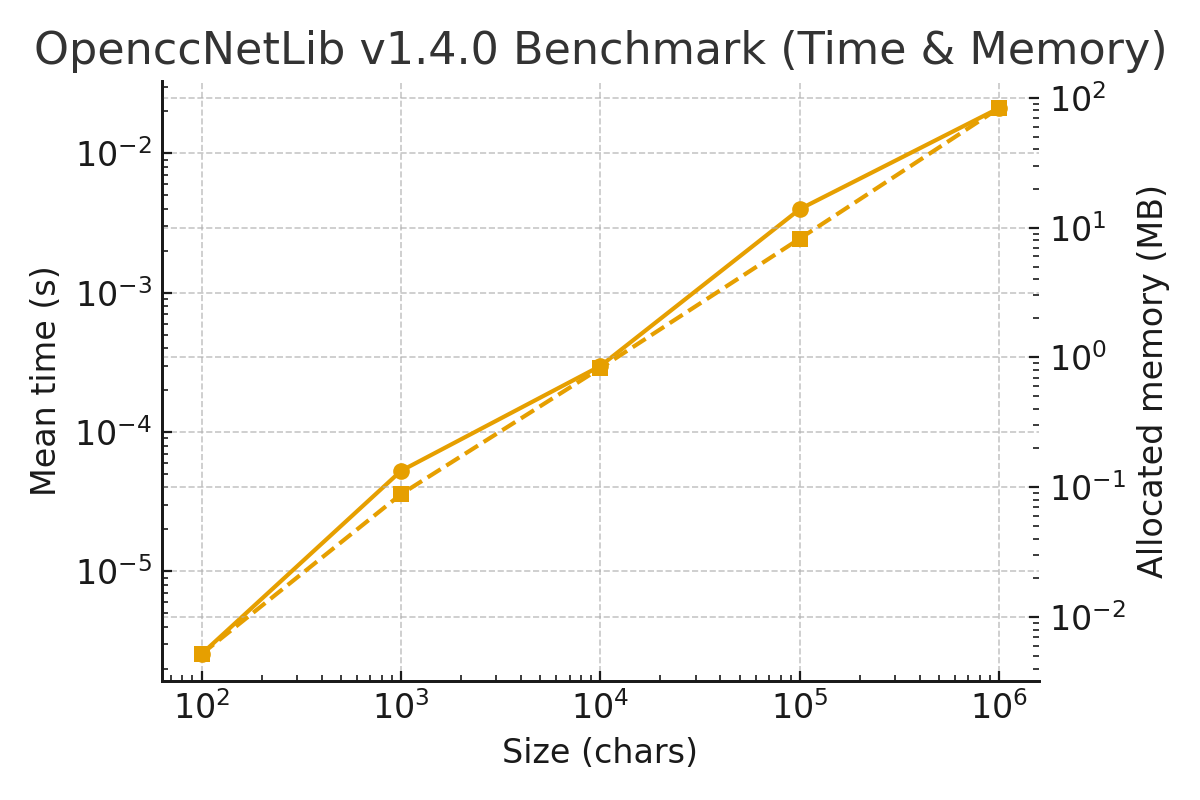
🚀 Performance Benchmark for OpenccNetLib 1.4.0
S2T Conversion (after Union-based Optimizations)
Environment
| Item | Value |
|---|---|
| BenchmarkDotNet | v0.15.6 |
| OS | Windows 11 (Build 26200.7171) |
| CPU | Intel Core i5-13400 (10C/16T @ 2.50 GHz) |
| .NET SDK | 10.0.100 |
| Runtime | .NET 10.0.0 (X64 RyuJIT x86-64-v3) |
| Iterations | 10 (1 warm-up) |
Results
| Method | Size | Mean | Error | StdDev | Min | Max | Rank | Gen0 | Gen1 | Gen2 | Allocated |
|---|---|---|---|---|---|---|---|---|---|---|---|
| BM_Convert_Sized | 100 | 2.55 µs | 0.05 µs | 0.03 µs | 2.53 µs | 2.63 µs | 1 | 0.515 | – | – | 5.3 KB |
| BM_Convert_Sized | 1,000 | 52.61 µs | 0.42 µs | 0.28 µs | 52.39 µs | 53.23 µs | 2 | 8.789 | – | – | 90.3 KB |
| BM_Convert_Sized | 10,000 | 297.87 µs | 11.36 µs | 7.52 µs | 288.43 µs | 312.53 µs | 3 | 83.496 | 19.043 | – | 845.9 KB |
| BM_Convert_Sized | 100,000 | 3.98 ms | 52.31 µs | 27.36 µs | 3.93 ms | 4.02 ms | 4 | 890.625 | 367.188 | 117.188 | 8,430.5 KB |
| BM_Convert_Sized | 1,000,000 | 21.17 ms | 594.50 µs | 393.23 µs | 20.87 ms | 22.01 ms | 5 | 8,468.75 | 1,468.75 | 625.000 | 85,580.4 KB |
Summary
- 100 chars → ~2.5 µs
- 1,000 chars → ~52 µs
- 10,000 chars → ~0.3 ms
- 100,000 chars → ~4 ms
- 1,000,000 chars (1M) → ~21 ms
This places OpenccNetLib 1.4.0 among the fastest .NET-based CJK converters,
on par with optimized Rust implementations and significantly faster than traditional trie-based segmenters.
⏱ Relative Performance Chart
🟢 Highlights (OpenccNetLib v1.4.0)
🚀 Performance Gain
Over 50% faster compared to earlier 1.x releases.
1M characters convert in ≈ 21 ms — roughly 47–50 million chars/sec
(≈ 95–100 MB/s) on a mid-range Intel i5-13400.📌 Predictable, Linear Performance (Performance Guarantee)
Both time and memory usage scale linearly with input size.
No spikes, no nonlinear slow paths, no GC stalls — ensuring:- deterministic latency for large documents
- consistent batch processing throughput
- stable behavior in multithreaded or server environments
This is the ideal profile for a high-performance conversion engine.
⚙️ Major Improvement Sources
- StarterUnion dense-table lookup
Eliminates per-key scanning; provides instant access to
(starterUnits, cap, minLen, 64-bit length mask). - Mask-first gating + shortest/longest bounds
Nearly all non-matching starters exit in a single branch. - Dropped
maxWordLengthparameter
Simplifies control flow and removes redundant checks. - Zero-allocation hot loop
UsesSpan<char>, thread-localStringBuilder, and rented buffers. - Optimized surrogate fast-path
UsingIsHs/IsLslookup tables removes per-iteration UTF-16 checks.
- StarterUnion dense-table lookup
📈 GC Profile
Extremely stable:- Allocations come mostly from final output & temporary key buffers.
- Very low Gen 1 activity; Gen 2 appears only on very large inputs (≥1M chars).
- No GC spikes even under high parallelism.
🏁 Throughput
- Sustained ≈ 95 MB/s (S2T) on .NET 10 RyuJIT x86-64-v3.
- Large documents (multi-million chars) convert in 40–50 ms, consistently.
💾 Memory Overhead
- 1M characters: ~85 MB allocated (includes output + chunk buffers).
- Only +2–3 MB vs earlier versions — an excellent tradeoff for major speed gains.
🧩 Future Optimization Ideas
- Tune splitting batch sizes (128–512 chars) for real workloads.
- Add thread-local scratch buffers (
localInit,localFinally) to reduce Gen 0 churn. - Multi-target .NET 8+ for span-based
Dictionary.TryGetValue. - Add micro-tables for extremely common keys (length 1–2).
- Explore SIMD-accelerated starter filtering.
Note:
Since OpenccNetLib v1.3.x, the global lazyPlanCacheeliminates repeated union builds,
reducing GC pressure and ensuring consistently fast conversions across all instances.
API Reference
Opencc Class
🔧 Constructors
Opencc(string config = null)
Creates a new converter using a configuration name (e.g.,"s2t","t2s").
This overload is compatible with existing code but requires string-based config.Opencc(OpenccConfig configEnum)
Creates a new converter using the strongly-typedOpenccConfigenum
(e.g.,OpenccConfig.S2T,OpenccConfig.T2S).
Recommended for all new code because it avoids magic strings.
🔁 Conversion Methods
string Convert(string inputText, bool punctuation = false)
Convert text according to the current config and punctuation mode.string S2T(string inputText, bool punctuation = false)string T2S(string inputText, bool punctuation = false)string S2Tw(string inputText, bool punctuation = false)string Tw2S(string inputText, bool punctuation = false)string S2Twp(string inputText, bool punctuation = false)string Tw2Sp(string inputText, bool punctuation = false)string S2Hk(string inputText, bool punctuation = false)string Hk2S(string inputText, bool punctuation = false)string T2Tw(string inputText)string T2Twp(string inputText)string Tw2T(string inputText)string Tw2Tp(string inputText)string T2Hk(string inputText)string Hk2T(string inputText)string T2Jp(string inputText)string Jp2T(string inputText)
⚙️ Configuration
string Config { get; set; }
Gets or sets the current config string. Invalid configs fallback to "s2t" and update error status.void SetConfig(string config)
Set the config using a string (e.g., "tw2sp"). Falls back to "s2t" if invalid.void SetConfig(OpenccConfig configEnum)
Set the config using a strongly typed OpenccConfig enum. Recommended for safety and IDE support.string GetConfig()
Returns the current config string (e.g., "s2tw").string GetLastError()
Returns the most recent error message, if any, from config setting.
📋 Validation and Helpers
static bool IsValidConfig(string config)
Checks whether the given string is a valid config name.static IReadOnlyCollection<string> GetSupportedConfigs()
Returns the list of all supported config names as strings.static bool TryParseConfig(string config, out OpenccConfig result)
Converts a valid config string to the correspondingOpenccConfigenum. Returnsfalseif invalid.static int ZhoCheck(string inputText)
Detects whether the input is likely Simplified Chinese (2), Traditional Chinese (1), or neither (0).
Dictionary Data
- Dictionaries are loaded and cached on first use.
- Data files are expected in the
dicts/directory (seeDictionaryLibfor details).
Add-On CLI Tools (Separated from OpenccNetLib)
OpenccNet dictgen
Description:
  Generate OpenccNetLib dictionary files.

Usage:
  OpenccNet dictgen [options]

Options:
  -f, --format <format>      Dictionary format: zstd|cbor|json [default: zstd]
  -o, --output <output>      Output filename. Default: dictionary_maxlength.<ext>
  -b, --base-dir <base-dir>  Base directory containing source dictionary files [default: dicts]
  -u, --unescape             For JSON format only: write readable Unicode characters instead of \uXXXX escapes
  -?, -h, --help             Show help and usage information
OpenccNet convert
Description:
  Convert text using OpenccNetLib configurations.

Usage:
  OpenccNet convert [options]

Options:
  -i, --input              Read original text from file <input>
  -o, --output             Write original text to file <output>
  -c, --config (REQUIRED)  Conversion configuration: s2t|s2tw|s2twp|s2hk|t2s|tw2s|tw2sp|hk2s|jp2t|t2jp
  -p, --punct              Punctuation conversion. [default: False]
  --in-enc                 Encoding for input: UTF-8|UNICODE|GBK|GB2312|BIG5|Shift-JIS [default: UTF-8]
  --out-enc                Encoding for output: UTF-8|UNICODE|GBK|GB2312|BIG5|Shift-JIS [default: UTF-8]
  -?, -h, --help           Show help and usage information
OpenccNet office
Description:
  Convert Office documents or Epub using OpenccNetLib.

Usage:
  OpenccNet office [options]

Options:
  -i, --input              Input Office document <input>
  -o, --output             Output Office document <output>
  -c, --config (REQUIRED)  Conversion configuration: s2t|s2tw|s2twp|s2hk|t2s|tw2s|tw2sp|hk2s|jp2t|t2jp
  -p, --punct              Enable punctuation conversion. [default: False]
  -f, --format             Force Office document format: docx | xlsx | pptx | odt | ods | odp | epub
  --keep-font              Preserve font names in Office documents [default: true]. Use --keep-font:false to disable. [default: True]
  --auto-ext               Auto append correct extension to Office output files [default: true]. Use --auto-ext:false to disable. [default: True]
  -?, -h, --help           Show help and usage information
OpenccNet pdf
Description:
  Convert a PDF to UTF-8 text using PdfPig + OpenccNetLib, with optional CJK paragraph reflow.

Usage:
  OpenccNet pdf [options]

Options:
  -i, --input <input>               Input PDF file <input.pdf>
  -o, --output <output>             Output text file <output.txt>
  -c, --config <config> (REQUIRED)  Conversion configuration: s2t|s2tw|s2twp|s2hk|t2s|tw2s|tw2sp|hk2s|jp2t|t2jp
  -p, --punct                       Enable punctuation conversion.
  -H, --header                      Add [Page x/y] headers to the extracted text.
  -r, --reflow                      Reflow CJK paragraphs into continuous lines.
  --compact                         Use compact reflow (fewer blank lines between paragraphs). Only meaningful with --reflow.
  -q, --quiet                       Suppress status and progress output; only errors will be shown.
  -?, -h, --help                    Show help and usage information
Usage Notes — OpenccNet pdf
PDF extraction engine
OpenccNet pdf uses a text-based PDF extraction engine (PdfPig) and is intended for digitally generated PDFs (
e-books, research papers, reports).
- ✅ Works best with selectable text
- ❌ Does not perform OCR on scanned/image-only PDFs
- ❌ Visual layout (columns, tables, figures) is not preserved
CJK paragraph reflow
The --reflow option applies a CJK-aware paragraph reconstruction pipeline, designed for Chinese novels, essays,
and academic text.
Reflow attempts to:
- Join artificially wrapped lines
- Repair cross-line splits (e.g.
面+容→面容) - Preserve headings, short titles, dialog markers, and metadata-like lines
⚠️ Important limitations
- Reflow is heuristic-based
- It is not suitable for:
- Poetry
- Comics / scripts
- Highly informal or experimental layouts
- Mainland web novels often use inconsistent formatting and may require tuning
--compact mode
When used together with --reflow, --compact:
- Reduces excessive blank lines
- Produces denser, book-like paragraphs
- Is recommended for long-form reading or further text processing
--compacthas no effect unless--reflowis enabled.
Page headers
Using --header inserts markers such as:
=== [Page 12/240] ===
This is useful for:
- Debugging extraction issues
- Locating original PDF pages
- Avoiding empty or ambiguous page boundaries
Quiet mode
--quiet suppresses:
- Progress bars
- Status messages
- Informational logs
Only errors will be printed.
Recommended for batch processing or script integration.
Output encoding
- Output text is always written as UTF-8
- Line endings follow the host platform
If you need other encodings, convert the output text using standard tools after extraction.
Recommended Workflows
Simple PDF → Traditional Chinese text
OpenccNet pdf -i input.pdf -o output.txt -c s2t -r
Compact novel conversion with page markers
OpenccNet pdf -i novel.pdf -o novel.txt -c s2tw -r --compact -H
Batch / automation use
OpenccNet pdf -i file.pdf -o out.txt -c t2s -r -q
Project That Use OpenccNetLib
- OpenccNetLibGui : A GUI application for
OpenccNetLib, providing a user-friendly interface for Chinese text conversion.
License
- This project is licensed under the MIT License. See the LICENSE file for details.
See THIRD_PARTY_NOTICES.md for bundled OpenCC lexicons (Apache License 2.0).
OpenccNet is not affiliated with the original OpenCC project, but aims to provide a compatible and high-performance solution for .NET developers.
| Product | Versions Compatible and additional computed target framework versions. |
|---|---|
| .NET | net5.0 was computed. net5.0-windows was computed. net6.0 was computed. net6.0-android was computed. net6.0-ios was computed. net6.0-maccatalyst was computed. net6.0-macos was computed. net6.0-tvos was computed. net6.0-windows was computed. net7.0 was computed. net7.0-android was computed. net7.0-ios was computed. net7.0-maccatalyst was computed. net7.0-macos was computed. net7.0-tvos was computed. net7.0-windows was computed. net8.0 was computed. net8.0-android was computed. net8.0-browser was computed. net8.0-ios was computed. net8.0-maccatalyst was computed. net8.0-macos was computed. net8.0-tvos was computed. net8.0-windows was computed. net9.0 was computed. net9.0-android was computed. net9.0-browser was computed. net9.0-ios was computed. net9.0-maccatalyst was computed. net9.0-macos was computed. net9.0-tvos was computed. net9.0-windows was computed. net10.0 was computed. net10.0-android was computed. net10.0-browser was computed. net10.0-ios was computed. net10.0-maccatalyst was computed. net10.0-macos was computed. net10.0-tvos was computed. net10.0-windows was computed. |
| .NET Core | netcoreapp2.0 was computed. netcoreapp2.1 was computed. netcoreapp2.2 was computed. netcoreapp3.0 was computed. netcoreapp3.1 was computed. |
| .NET Standard | netstandard2.0 is compatible. netstandard2.1 was computed. |
| .NET Framework | net461 was computed. net462 was computed. net463 was computed. net47 was computed. net471 was computed. net472 was computed. net48 was computed. net481 was computed. |
| MonoAndroid | monoandroid was computed. |
| MonoMac | monomac was computed. |
| MonoTouch | monotouch was computed. |
| Tizen | tizen40 was computed. tizen60 was computed. |
| Xamarin.iOS | xamarinios was computed. |
| Xamarin.Mac | xamarinmac was computed. |
| Xamarin.TVOS | xamarintvos was computed. |
| Xamarin.WatchOS | xamarinwatchos was computed. |
-
.NETStandard 2.0
- PeterO.Cbor (>= 4.5.5)
- System.Memory (>= 4.6.3)
- System.Text.Json (>= 8.0.5)
- ZstdSharp.Port (>= 0.8.6)
NuGet packages
This package is not used by any NuGet packages.
GitHub repositories
This package is not used by any popular GitHub repositories.
OpenccNetLib v1.4.0
• Added SerializeToJsonUnescaped() for human-readable UTF-8 JSON output
• Added DecodeJsonSurrogatePairs() helper for restoring non-BMP CJK
• Added "dictgen --unescape" option for generating unescaped dictionaries
• Removed all maxWordLength parameters – now unified under StarterUnion.GlobalCap
• Moved OpenccConfig enum to top-level namespace (cleaner API; compatible)
• Updated ApplySegmentReplace to simplified delegate (legacy overload preserved)
• Improved XML docs and internal metadata descriptions
• More robust FromDicts() handling of missing/optional dictionary files
• No behavior changes; conversion results identical
• Only SetConfig(OpenccConfig) callers using the old nested enum must update