Bitvantage.InternetProtocol.NetworkPrefixLookup
3.0.0
Prefix Reserved
See the version list below for details.
dotnet add package Bitvantage.InternetProtocol.NetworkPrefixLookup --version 3.0.0
NuGet\Install-Package Bitvantage.InternetProtocol.NetworkPrefixLookup -Version 3.0.0
<PackageReference Include="Bitvantage.InternetProtocol.NetworkPrefixLookup" Version="3.0.0" />
<PackageVersion Include="Bitvantage.InternetProtocol.NetworkPrefixLookup" Version="3.0.0" />
<PackageReference Include="Bitvantage.InternetProtocol.NetworkPrefixLookup" />
paket add Bitvantage.InternetProtocol.NetworkPrefixLookup --version 3.0.0
#r "nuget: Bitvantage.InternetProtocol.NetworkPrefixLookup, 3.0.0"
#:package Bitvantage.InternetProtocol.NetworkPrefixLookup@3.0.0
#addin nuget:?package=Bitvantage.InternetProtocol.NetworkPrefixLookup&version=3.0.0
#tool nuget:?package=Bitvantage.InternetProtocol.NetworkPrefixLookup&version=3.0.0
Bitvantage.InternetProtocol.NetworkPrefixLookup
Longest-prefix-match lookups for IPv4 and IPv6 in .NET. Given an address, a lookup finds the most specific stored network that contains it and the value stored with that network. The library is built for routing tables, access lists, packet classification and GeoIP data, and it scales to full Internet routing tables.
- Fast lookups. On a full routing table of a million IPv4 prefixes, a lookup takes about 26 ns on an AMD Ryzen 7 7800X3D and about 100 ns on one 2.8 GHz cloud core, and a frozen table returns the value for an integer address in 6.3 ns on the Ryzen and 43 ns on the cloud core. Lookups allocate nothing.
- Faster than Go's BART. Lookups of addresses spread across a full routing table are 1.1 to 2.6 times as fast as in BART, the Go library whose design the read-write table follows, and writes that concurrent readers can share are 2.3 to 3.2 times as fast.
- Reads never wait. Any number of threads look up without locks while another thread writes. Each lookup sees the table as it was at one moment, and every write does a bounded amount of work, so there are no pauses for growth or compaction.
- Frozen tables for data that is loaded once and then only read.
- Queries about networks: the routes that cover a subnet, the networks allocated inside a block, and whether a new rule overlaps an existing one.
- MaxMind databases load into a lookup that answers 5 to 10 times as fast as MaxMind's own reader.
- Any network type.
System.Net.IPNetworkis built in, two packages addIPNetwork2and MaxMind networks, and an adapter of four static methods adds your own type. - No dependencies in the core package. It targets .NET 8 and .NET 10, supports trimming and native AOT, and ships Source Link and symbols.
Quick start
dotnet add package Bitvantage.InternetProtocol.NetworkPrefixLookup
Or from the NuGet Package Manager console:
PM> NuGet\Install-Package Bitvantage.InternetProtocol.NetworkPrefixLookup
using System.Net;
using Bitvantage.InternetProtocol.NetworkPrefixLookup;

var routes = new IPNetworkLookup<int>
{
    { IPNetwork.Parse("10.0.0.0/8"), 64512 },
    { IPNetwork.Parse("10.1.0.0/16"), 64513 },
    { IPNetwork.Parse("2001:db8::/32"), 64514 },
};

// the most specific stored network that contains the address
if (routes.TryGetMatch(IPAddress.Parse("10.1.2.3"), out var network, out var asn))
    Console.WriteLine($"{network} -> AS{asn}"); // 10.1.0.0/16 -> AS64513

// every stored network that contains it, most specific first
foreach (var match in routes.GetMatches(IPAddress.Parse("10.1.2.3")))
    Console.WriteLine(match.Prefix); // 10.1.0.0/16, then 10.0.0.0/8

// a read-only copy with faster lookups
var snapshot = routes.Freeze();
| Package | Adds |
|---|---|
Bitvantage.InternetProtocol.NetworkPrefixLookup |
Lookups over System.Net.IPNetwork and your own network types, and tries over keys other than IP addresses |
Bitvantage.InternetProtocol.NetworkPrefixLookup.IPNetwork2 |
Lookups over System.Net.IPNetwork2 from the IPNetwork2 package |
Bitvantage.InternetProtocol.NetworkPrefixLookup.MaxMind |
Lookups over MaxMind networks, and loading a whole GeoIP2 or GeoLite2 database |
Performance
Measured on 2026-11-09 on an AMD Ryzen 7 7800X3D at 4.2 GHz with .NET 10 and BenchmarkDotNet, with the CAIDA RouteViews tables of September 2025: 1,054,037 IPv4 and 239,598 IPv6 prefixes. Each of a million lookups is for a random address inside a randomly chosen prefix. The times are the mean per lookup. On .NET 8 lookups take about a fifth longer.
| Lookup | Read-write, IPv4 | Read-write, IPv6 | Frozen, IPv4 | Frozen, IPv6 |
|---|---|---|---|---|
TryGetMatch from an IPAddress, returning the network and the value |
26 ns | 59 ns | 11 ns | 26 ns |
TryGetMatch from a uint or UInt128, returning the network and the value |
23 ns | 54 ns | 8.0 ns | 24 ns |
TryGetMatchValue from a uint or UInt128 |
6.3 ns | 22 ns |
This processor's 96 MB L3 cache can hold any one of these tables, so memory reads that miss the smaller caches can be
served from it rather than from main memory. Where the table does not fit in the cache, lookups take longer: on a 4-core
cloud Xeon at 2.8 GHz on 2026-10-23, TryGetMatch from an IPAddress took 107 ns for IPv4 and 204 ns for IPv6 on the
read-write tables, and TryGetMatchValue from an integer 43 ns and 103 ns on the frozen ones.
With the compressed layout, the frozen tables take 11 ns for IPv4 and 30 ns for IPv6 from an integer. On a table of
1,000 prefixes, small enough to stay in the faster caches, a lookup from an IPAddress takes 9 ns for IPv4 and 20 ns for
IPv6, and a frozen one 4 ns and 16 ns. No lookup allocates.
Memory. The read-write table holds 32 MB for the IPv4 table and 14 MB for the IPv6 table. Each stored IPNetwork
adds an IPAddress object of 40 bytes for an IPv4 prefix and 80 bytes for an IPv6 prefix. A frozen copy holds 68 MB for
IPv4 and 65 MB for IPv6 with the leaf-pushed layout, which Freeze chooses for these tables, or 47 MB and 17 MB with the
compressed layout.
Writes. Building a table from a sequence of prefixes takes 0.05 s for the IPv4 table and 0.02 s for the IPv6 table, or 0.09 s and 0.03 s when the prefixes arrive shuffled. A single write takes 0.18 to 0.26 µs when the prefixes arrive in address order, and 0.22 µs when every thousandth prefix of the IPv4 table is removed and added back. Each write allocates 1.1 to 1.8 KB, because it copies the node it changes instead of changing it under readers.
Compared with Go's BART. Both libraries ran on the 4-core cloud Xeon on 2026-10-23, with the same tables and
addresses, and returned the same answers. Removing and adding back 100,000 random prefixes of the full tables took 3 to
4.5 µs per write there. BART takes netip.Addr values; this library took IPAddress objects. Each cell gives IPv4,
then IPv6.
BART Table |
This library, read-write | This library, frozen | |
|---|---|---|---|
| Lookup returning the value | 199 / 246 ns | 99 / 221 ns | 75 / 148 ns |
| Lookup returning the network and the value | 279 / 303 ns | 107 / 204 ns | 83 / 208 ns |
| Contains | 84 / 126 ns | 39 / 91 ns | |
| Memory | 24 / 10 MB | 32 / 14 MB, plus the IPNetwork objects |
|
| A write that concurrent readers can share | 10.4 / 9.3 µs | 4.5 / 2.9 µs |
The IPv6 times of this library predate the change that let the conversion of IPv6 addresses inline, which on the Ryzen
made IPv6 lookups from IPAddress objects 10 to 40 ns faster.
BART uses less memory, and its in-place writes take 0.4 to 0.5 µs when nothing reads the table at the same time. Its
Fast table beats this library's read-write table on IPv6 when everything stays in cache.
Bart-Comparison.md
has the method and every measurement,
Architecture.md
has BenchmarkDotNet measurements of the other operations, and
Documentation/Benchmarks
has the full reports of the run above.
Choosing a table
| Your data | Use |
|---|---|
| Changes while it is read, such as a routing table fed by BGP | IPNetworkLookup<TValue> |
| Loaded once and then only read, such as a GeoIP or blocklist snapshot | Freeze(), which returns a FrozenIPNetworkLookup<TValue> |
| Networks without values, such as an access list | IPNetworkLookup<NoValue> |
| A MaxMind GeoIP2 or GeoLite2 database | MaxMindDatabase.Load |
IPNetwork2 networks |
IPNetwork2Lookup<TValue> |
| Networks of your own type | IPPrefixLookup<TPrefix, TAdapter, TValue> with an adapter |
| Keys that are not IP addresses | BitTrie<TKey, TPrefix, TValue> |
On a full routing table a frozen table returns values in 0.3 to 0.5 of the read-write time. Every lookup type has the
same read-only interface, IReadOnlyIPPrefixLookup<TPrefix, TValue>, so code that only reads works with either form.
Looking up
| Method | Finds |
|---|---|
TryGetMatch(address, out prefix, out value) |
The most specific stored network that contains an address |
TryGetMatchValue(address, out value) |
The same when only the value is needed, which is slightly faster |
TryGetMatchIPv4(uint, …), TryGetMatchIPv6(UInt128, …), TryGetMatch(ReadOnlySpan<byte>, …) |
The same from an integer or from bytes in network order, for callers such as packet parsers that never build an IPAddress |
ContainsMatch(address) |
Whether any stored network contains an address |
GetMatches(address) |
Every stored network that contains an address, most specific first. An overload fills a span instead of a list, and the integer and byte forms exist as well |
TryGetMatch(network, out prefix, out value) |
The most specific stored network that contains another network, which may be the network itself |
GetMatches(network) |
Every stored network that contains another network, most specific first: the routes that cover a subnet |
GetSubnets(network) |
Every stored network inside another network, in address order: what is allocated inside a block. The networks are produced as you enumerate, so GetSubnets(block).Any() stops at the first |
Overlaps(network) |
Whether any stored network contains another network or lies inside it, such as a new rule that collides with an existing one |
TryGetValue(network, out value), ContainsPrefix(network) |
Exactly this network, as a dictionary would |
Count and enumeration cover both address families: the IPv4 networks first, then the IPv6 networks, each in address
order. IPv4Count and IPv6Count count one family each. Lookups ignore the scope ID of an IPv6 address such as
fe80::1%7, so link-local rules cannot be told apart by interface.
Tables that change
Writes follow dictionary rules: TryAdd, Add, AddOrUpdate, GetOrAdd, Remove and Clear. As in
ConcurrentDictionary, TryUpdate and TryRemove change a prefix only when its value is the expected one. The check and
the write happen under the writer lock, so no other thread's write can land between them.
- Reads never wait. Any number of threads can look up while writes happen. Lookups take no locks, and each sees the table as it was at one moment: before or after every write, never in between.
- Writes are serialized by an internal lock, so several threads can write without coordinating.
- Every write does bounded work. A write copies only the node it changes, and the garbage collector frees the old one, so no write pauses for growth or compaction however large the table gets.
A batch publishes many changes at once:
using (var batch = routes.BeginBatch())
{
    foreach (var (prefix, asn) in feed)
        routes.AddOrUpdate(prefix, asn);
    batch.Commit(); // readers see all of it from here; disposing without Commit discards it
}
Each address family commits all at once, IPv4 a moment before IPv6. A batch holds the writer lock until it ends, so
other threads' writes wait until then. The lock belongs to the thread that started the batch, so a batch cannot span an
await, and ending it on another thread throws and leaves it open. If a write inside the batch throws, Commit throws
and discards the batch, because the write may have left it half done.
To load a whole table, pass the prefixes to the constructor. It builds the trie in one pass from prefixes in any order, 1.3 to 4 times as fast as a batch, with a third less allocation. It takes key-value pairs such as a dictionary, or the entries of another lookup or of a query:
var copy = new IPNetworkLookup<int>(routes);
var site = new IPNetworkLookup<int>(routes.GetSubnets(IPNetwork.Parse("10.1.0.0/16")));
Version changes with every published change, so a cache of lookup results can be checked with one comparison. Read it
before the lookups it is to vouch for.
Frozen tables
Freeze builds a read-only copy with faster lookups:
FrozenIPNetworkLookup<int> origins = new IPNetworkLookup<int>(LoadPrefixes()).Freeze();

// on many threads
if (origins.TryGetMatchValue(sourceAddress, out var origin))
    Count(origin);
To change a frozen table, change the read-write table, freeze it again and swap the reference. Readers switch on their next lookup. Freezing makes writers wait only while it copies the prefixes out, and it never makes readers wait.
A frozen table has one of two layouts. The leaf-pushed layout is the fastest for clustered tables such as routing
tables. The compressed layout uses much less memory, and it is also faster when the prefixes are scattered across the
address space, as random host routes are. Leaf-pushed tables of scattered prefixes grow very large: 100,000 random IPv6
/128 prefixes take 1.4 GB leaf-pushed and 56 MB compressed. By default Freeze chooses the layout for each address family
from its data. To choose it yourself:
var small = routes.Freeze(new FrozenBitTrieOptions { Layout = FrozenLayout.Compressed });
Freeze(ipv4Options, ipv6Options) takes separate options for each address family.
MaxMind databases
MaxMind's Reader maps a database file and, on every lookup, walks the file's search tree one bit at a time and decodes
the record it reaches. MaxMindDatabase.Load decodes every record once and builds a lookup from the networks:
using System.Net;
using Bitvantage.InternetProtocol.NetworkPrefixLookup;

var countries = MaxMindDatabase.Load<Dictionary<string, object>>("GeoLite2-Country.mmdb").Freeze();
if (countries.TryGetMatchValue(IPAddress.Parse("81.2.69.160"), out var record))
    Console.WriteLine(((Dictionary<string, object>)record["country"])["iso_code"]); // GB
On the Ryzen above, with a database the size of a full routing table, 1,240,422 IPv4 and 413,309 IPv6 networks written from the RouteViews tables:
MaxMind Reader.Find |
Read-write lookup | Frozen lookup | |
|---|---|---|---|
| Time per lookup | 254 ns | 38 ns | 27 ns |
| Allocated per lookup | 344 bytes | Nothing | Nothing |
The lookup costs time to load and memory to hold. That database took 0.9 seconds to load and the read-write lookup held 225 MB, where the reader opens at once and maps the 19 MB file. The lookup pays off when an application looks up many addresses, such as a server that checks every request or a job that processes logs. For a few lookups, or where memory is tight, MaxMind's reader is the better choice.
The lookup also answers questions the reader cannot, through the queries about networks, and it can hold networks of your own next to MaxMind's or replace some of them before you freeze it.
MaxMind lookups map IPv4-mapped addresses such as ::ffff:81.2.69.160 to IPv4 by default, as MaxMind's reader does.
MaxMind's IPv6 databases also answer some IPv6 addresses from the IPv4 data, through IPv4-compatible, 6to4 and Teredo
aliases. Set MaxMindLoadOptions.IncludeAliasedNetworks to load those too. Every address then gets the answer that
Reader.Find gives, and each IPv4 network is stored three more times: under ::/96, 2001::/32 and 2002::/16.
Load only databases you trust. A database's search tree can point many branches at one subtree, as MaxMind's aliases do, so a hostile file of a few hundred bytes can expand into millions of networks. The records are shared between networks and must not be changed.
IPNetwork2 and your own network types
The IPNetwork2 package works the same way:
using System.Net;
using Bitvantage.InternetProtocol.NetworkPrefixLookup;

var zones = new IPNetwork2Lookup<string> { { IPNetwork2.Parse("192.168.0.0/16"), "office" } };
For a network type of your own, implement IIPPrefixAdapter<TPrefix> on an empty struct and use
IPPrefixLookup<TPrefix, TAdapter, TValue>:
public readonly struct MyNetworkAdapter : IIPPrefixAdapter<MyNetwork>
{
    public static bool IsIPv4(MyNetwork network) => network.Address.AddressFamily == AddressFamily.InterNetwork;
    public static uint GetIPv4Bits(MyNetwork network) => IPAddressBits.ToIPv4Bits(network.Address);
    public static UInt128 GetIPv6Bits(MyNetwork network) => IPAddressBits.ToIPv6Bits(network.Address);
    public static int GetLength(MyNetwork network) => network.Length;
}

var lookup = new IPPrefixLookup<MyNetwork, MyNetworkAdapter, string>();
The adapter's members are static, so the JIT compiles them into the lookups at no cost.
More features
Addresses from dual-mode sockets
A socket that accepts both IPv4 and IPv6 connections reports an IPv4 client as an IPv4-mapped IPv6 address, such as
::ffff:203.0.113.5. By default the lookups take every address as given, so such an address only matches IPv6
networks. When your addresses come from such a socket, turn mapping on, and ::ffff:203.0.113.5 gets exactly the answer
of 203.0.113.5:
var acl = new IPNetworkLookup<bool>(new IPLookupOptions { MapIPv4MappedAddresses = true });
Leave mapping off for addresses read from packets. There a mapped address is malformed or crafted, and treating it as IPv4 would let it match IPv4 rules.
With mapping on, the queries about networks follow the addresses: ::ffff:10.1.0.0/112 gets the answers of
10.1.0.0/16, and a network that contains all of ::ffff:0:0/96, such as ::/0, contains every IPv4 network too. An
IPv6 prefix inside ::ffff:0:0/96 could never match an address, so adding one throws ArgumentException. Add the IPv4
prefix instead.
Sets of networks without values
Use NoValue as the value type. The extension methods TryAdd(prefix), Add(prefix) and
TryGetMatch(address, out prefix) then need no value:
var blocked = new IPNetworkLookup<NoValue> { IPNetwork.Parse("192.0.2.0/24"), IPNetwork.Parse("2001:db8::/32") };
if (blocked.ContainsMatch(clientAddress))
    Reject();
Keys other than IP addresses
The IP lookups are built on BitTrie<TKey, TPrefix, TValue> and FrozenBitTrie<TKey, TPrefix, TValue>, which work on
bits and lengths only. Both are public, with Bits32 keys for IPv4 and Bits128 keys for IPv6, for callers who want one
address family without the IP layer, or any other key that fits in 32 or 128 bits:
var trie = new BitTrie<Bits32, string, int>();
trie.Add(new Bits32(0x0A000000), 8, "10.0.0.0/8", 1);
trie.TryGetMatch(new Bits32(0x0A010203), out var prefix, out var value); // "10.0.0.0/8", 1
Bits32 and Bits128 are the only key types. The trie trusts its keys' bit arithmetic for memory safety, so no other
assembly can implement IBitKey<TSelf>. For context such as a VRF, use one lookup per VRF rather than a wider key. An
empty lookup holds only a few KB.
Inspecting a table
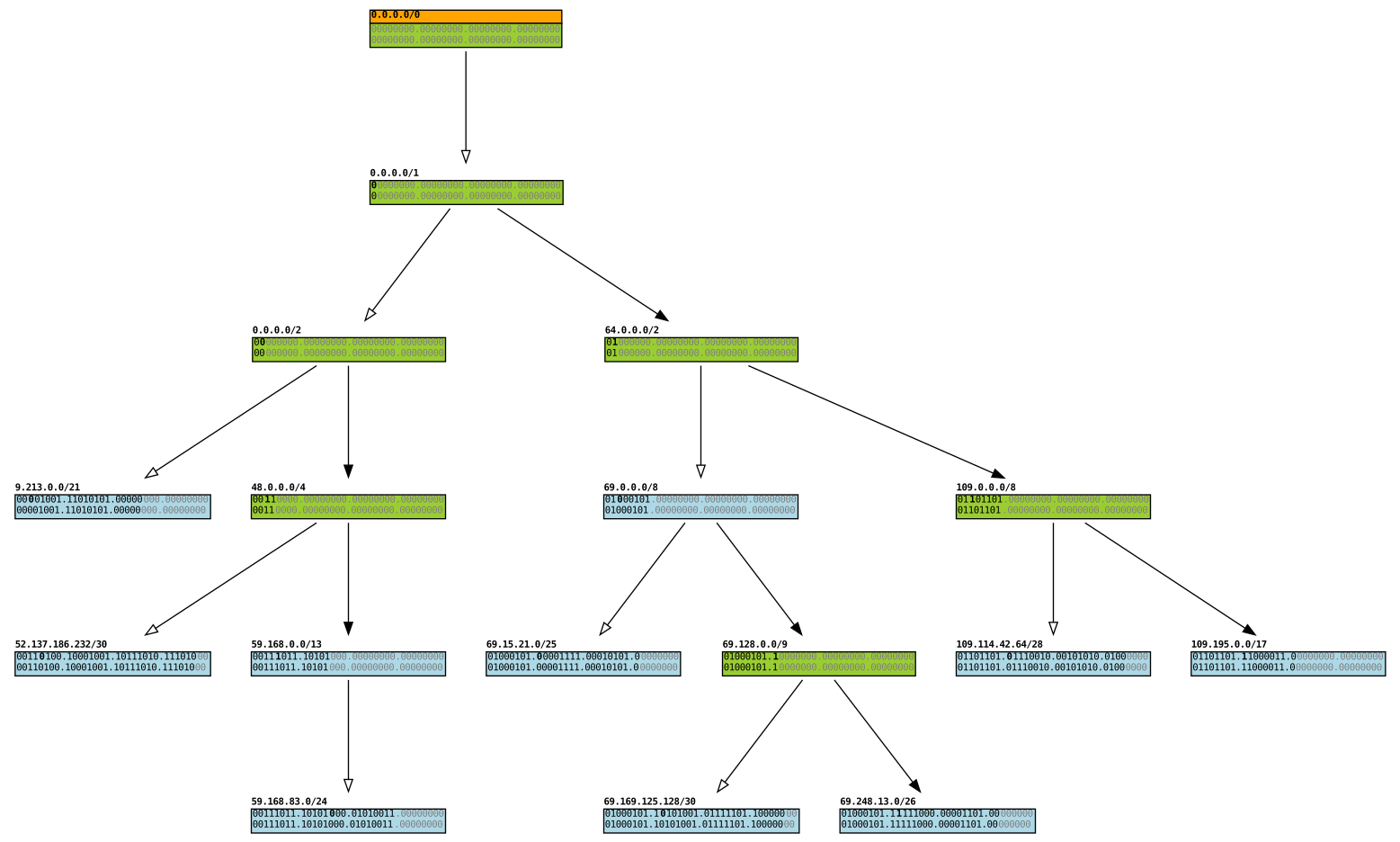
ToTextTree prints the trie of one address family, and ToDotTree writes it in the DOT language for Graphviz.
GetStatistics reports the number of nodes and the bytes they hold.
The drawing below holds the first 100 prefixes announced in 215.0.0.0/8. Each box is a node, headed by the bits that
lead to it, and lists the prefixes it stores in address order. A fringe is a prefix that ends on the node's last bit.
A wider drawing
holds the first 1,000 prefixes in 2a02::/16, and its ellipses are leaves.

How it works
The read-write table follows BART, the Balanced Routing Table by Karl Gaissmaier, a multibit trie for Go.
- Nodes of 8 bits. Each node decides one octet of the address, so an IPv4 lookup passes at most 4 nodes and an IPv6 lookup at most 16.
- Prefixes inside a node. A prefix that ends 0 to 7 bits into a node's octet takes one of 255 positions in a complete binary tree, numbered as in Donald Knuth's Allotment Routing Table: position 1 is the prefix of length 0, which covers every value of the octet, and position i has the children 2i and 2i + 1. A 256-bit set marks the positions that hold a prefix, and an array holds one slot per set bit. The slot of a position is the number of set bits below it, which one popcount instruction counts, so a node stores only the prefixes it has.
- The longest match in one step. For each of the 256 values of an octet, a precomputed 256-bit set holds the positions that contain it. The AND of that set and the node's set leaves the prefixes that contain the address, and the highest remaining bit is the longest of them.
- Fringes and leaves. A prefix that ends exactly at the end of a node's octet, such as a /24 in the node for the third octet, is stored as a fringe in that node. A single longer prefix below an octet is stored whole as a leaf. Neither needs a node of its own, so a typical /24 or an isolated long prefix costs one array slot. Child nodes are found with a 256-bit set and a popcount in the same way, and a child exists only where two or more prefixes lie below an octet. The shape of the trie therefore depends only on the prefixes it holds.
- Lookups descend as far as the address leads, then check the nodes from the deepest one up. The first match is the longest.
This library adds three things to that design:
- Shortcut blocks. For each first octet that leads to a node, a block of 256 references points at the nodes two levels down, so most lookups start at the third level after one read.
- Copy-on-write with lock-free readers. A write copies the one node it changes, finishes the copy, and links it in with a single reference write, so readers never see half a change and never take a lock. A lookup that overlaps two writes notices it through a change counter and looks again.
- Frozen tables.
Freezeflattens the trie into tables indexed by the address bits. The leaf-pushed layout pushes every answer down to the end of its path, so a lookup reads a 16-bit root table and one 8-bit table for each further octet that still needs deciding, and reads nothing else. The compressed layout stores the same answers in nodes of 6 bits with popcount-compressed bitmaps, as Poptrie does, and needs far less memory for scattered prefixes.
Architecture.md describes the design in detail, and the other documents in Documentation record how it was chosen and measured.
Credits
- BART by Karl Gaissmaier, github.com/gaissmai/bart, MIT License. The read-write trie takes its node layout, its use of the ART numbering, and its fringes and leaves from BART.
- The Allotment Routing Table by Donald E. Knuth, and Yoichi Hariguchi's description of it, which BART builds on.
- Poptrie by Hirochika Asai and Yasuhiro Ohara: "Poptrie: A Compressed Trie with Population Count for Fast and Scalable Software IP Routing Table Lookup", ACM SIGCOMM 2015. The compressed frozen layout follows it.
- Leaf pushing by V. Srinivasan and George Varghese: "Fast Address Lookups Using Controlled Prefix Expansion", ACM Transactions on Computer Systems, volume 17, number 1, 1999. The leaf-pushed frozen layout follows it.
- The CAIDA UCSD RouteViews Prefix-to-AS mappings dataset for IPv4 and IPv6 supplies the real tables that the benchmarks use.
- MaxMind publishes the MaxMind DB format and the test databases in
Test/Data/MaxMind, under the Apache License 2.0 or the MIT License.
License
MIT License. Changes between releases are listed in CHANGELOG.md.
| Product | Versions Compatible and additional computed target framework versions. |
|---|---|
| .NET | net8.0 is compatible. net8.0-android was computed. net8.0-browser was computed. net8.0-ios was computed. net8.0-maccatalyst was computed. net8.0-macos was computed. net8.0-tvos was computed. net8.0-windows was computed. net9.0 was computed. net9.0-android was computed. net9.0-browser was computed. net9.0-ios was computed. net9.0-maccatalyst was computed. net9.0-macos was computed. net9.0-tvos was computed. net9.0-windows was computed. net10.0 is compatible. net10.0-android was computed. net10.0-browser was computed. net10.0-ios was computed. net10.0-maccatalyst was computed. net10.0-macos was computed. net10.0-tvos was computed. net10.0-windows was computed. |
-
net10.0
- No dependencies.
-
net8.0
- No dependencies.
NuGet packages (2)
Showing the top 2 NuGet packages that depend on Bitvantage.InternetProtocol.NetworkPrefixLookup:
| Package | Downloads |
|---|---|
|
Bitvantage.InternetProtocol.NetworkPrefixLookup.MaxMind
Loads a whole MaxMind DB file, such as GeoIP2, GeoLite2 or ASN, into a lookup table for fast longest-prefix-match lookups by address. |
|
|
Bitvantage.InternetProtocol.NetworkPrefixLookup.IPNetwork2
Longest-prefix-match lookups over IPNetwork2 networks from the IPNetwork2 package. |
GitHub repositories
This package is not used by any popular GitHub repositories.